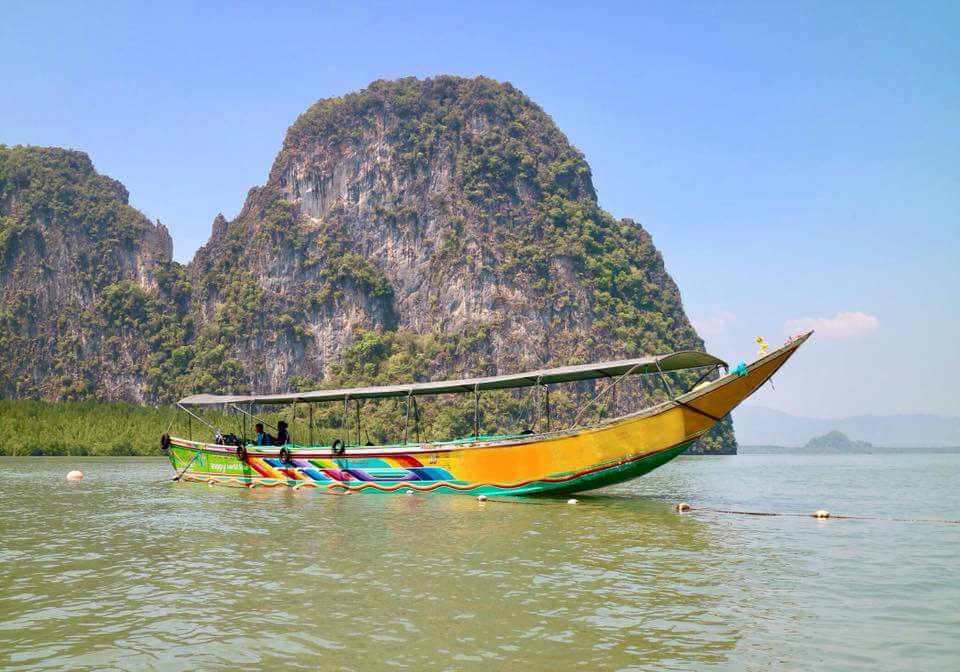
Khao Phing Kan – The Real Name of James Bond Island
Khao Phing Kan is the true Thai name of the famous James Bond Island. It sits in Phang Nga Bay, inside Ao Phang Nga National Park. Most tourists call it James Bond Island because of a film from 1974. But local people know it as Khao Phing Kan. This page gives facts, not fancy words. No hidden secrets. Just honest information for travellers.
🎬 Ready to see Khao Phing Kan in real life? 🎬
Choose from our range of boat tours – longtail, speedboat, or private charter. Explore Phang Nga Bay with trusted local guides.
🚤 Explore All James Bond Island Tours →✓ Best price guarantee ✓ Hotel pickup ✓ Free cancellation
Where Is Khao Phing Kan?
Khao Phing Kan is in the north-east of Phuket, about 25 kilometres away. The exact coordinates are 8°16′N 98°30′E. It belongs to Phang Nga Bay, a large area of green water with more than 40 limestone islands. The island is part of Ao Phang Nga National Park, which was established in 1981. For more about the park, read our Ao Phang Nga National Park guide.
Visitors reach Khao Phing Kan by boat from Phuket, Krabi or Koh Samui. There is no road, no airport, no bridge. Only water connects it to the mainland. The nearest human settlement is Koh Panyee, a floating Muslim village built on wooden stilts. Local fishermen have lived there for generations, and today it is a popular stop for lunch during tours.
What Does “Khao Phing Kan” Mean?
In the Thai language, “Khao” means mountain or hill. “Phing” means to lean or tilt. “Kan” means together or side by side. So Khao Phing Kan translates to “hills leaning against each other”. This name perfectly describes the island. Two main limestone hills stand side by side, leaning slightly towards each other. Between them there is a small sandy beach and a narrow passage. When the tide is low, you can walk from one hill to the other.
The famous nail‑shaped rock, Ko Tapu, is not part of Khao Phing Kan. It stands about 40 metres away from the main island. Many first‑time visitors confuse the two. Ko Tapu means “nail island”. It looks exactly like a giant rusty nail sticking out of the emerald water. That single rock became the true icon of the James Bond film, not the main island. However, the whole area is now collectively called James Bond Island. Locals still use the old names.
Geology: How the Island Formed
Khao Phing Kan is made of limestone karst. This type of rock began forming 295 to 250 million years ago during the Permian Period. At that time, the whole region was a shallow, warm sea full of marine creatures. Their shells and skeletons fell to the seabed, layer after layer, and slowly turned into limestone. Later, movements of the Earth’s crust pushed the rock upwards. Rainwater, which is slightly acidic, dissolved the soft limestone over millions of years. This created steep cliffs, sharp towers, caves, and hidden holes. Geologists call this process “karstification”.
The result is a classic limestone karst tower. The tower rises 20 to 25 metres above the sea. Its sides are almost vertical, making it impossible to climb without ropes. Some parts have small, shallow caves – but none of them go deep. The rock is grey and white, with sharp, jagged edges. At the base, the sea has undercut the tower, forming a small beach only at very low tide. Geologists call a standalone eroded rock a “sea stack”. Khao Phing Kan is not a sea stack because it is a twin‑hill formation. But Ko Tapu, the nail rock, is a true sea stack. Learn more about sea stack formation here.
Because limestone is relatively soft, visitors must never knock off pieces or carve their names. The national park guards patrol the area and impose fines starting at 5,000 THB (about 140 USD) for damaging the rock. Respect the geology – it took nature 250 million years to build this view.
Film History: How It Became James Bond Island
In 1974, the film The Man with the Golden Gun used Khao Phing Kan and Ko Tapu as the secret hideout of the villain Francisco Scaramanga. The director, Guy Hamilton, chose this location because the limestone cliffs looked futuristic and alien. In the movie, Scaramanga (played by Christopher Lee) lives in a solar‑powered island filled with mirrors and traps. James Bond (played by Roger Moore) arrives by seaplane and fights Scaramanga inside a cave full of mirrors. The iconic shot of Ko Tapu appears on screen for only a few seconds, but it left a lasting impression.
After the film’s release, tourists from all over the world began asking to see the “James Bond Island”. Local boat drivers quickly adopted the nickname. The Thai government later installed a sign that says “James Bond Island” in English to help tourists find the spot. However, the official registered name in the national park records is still Khao Phing Kan. Even today, many visitors bring toy golden guns and pose for photos mimicking the famous scene. The movie turned an unknown limestone hill into a global tourism magnet. Today, more than 2,000 people visit every day during peak season. For more film locations, see our James Bond filming locations page.
What to Do at Khao Phing Kan Today
Most boat tours stop at Khao Phing Kan for 45 minutes to one hour. That is plenty of time because the island is very small. Only one small beach is accessible, and the rest is steep rock. A typical visit includes: walking on the sand at low tide, taking photos with Ko Tapu in the background, peeking into the two shallow caves on the western side, and reading the national park information boards. There are no shops, no toilets, no restaurants – just nature. You must bring your own water and sunscreen. For a complete packing list, read what to pack for Phang Nga Bay.
Swimming is not allowed directly around Khao Phing Kan. The water is shallow, rocky, and tour boats come and go constantly. It is not safe. Instead, most tours include a stop at Hong Island or Panak Island for swimming and snorkelling. Also, do not attempt to climb the limestone cliffs. The rock is brittle and the park guards watch carefully. Violators are fined and may be banned from the park.
Wildlife You Might See
Even though Khao Phing Kan is crowded, some wild animals still survive there. With a little patience, you can spot: crab‑eating macaques (small grey monkeys) sitting on the rocks – do not feed them, they bite and can carry diseases; monitor lizards up to one metre long – they usually run away from humans; white‑bellied sea eagles circling above the bay – they hunt fish and small snakes; and bats inside the limestone cracks – they emerge at dusk to eat insects. Under the water near the island, the seabed is mostly mud and rock. There is little coral. Good snorkelling is found elsewhere in Phang Nga Bay, such as around Hong Island or the coral gardens near Koh Khai. For more animals, visit our wildlife guide to Phang Nga Bay.
Best Time to Visit Khao Phing Kan
The best months are November to February. During this period, the sky is clear, the sea is calm, and the temperature is about 28°C (82°F). Humidity is low and rain is rare. From March to May, the weather becomes very hot – up to 35°C (95°F) – and the air is sticky. June to October is the monsoon season. The wind picks up, waves can reach one metre, and heavy showers may last for hours. Some tour operators cancel trips if the waves are too dangerous. However, because Khao Phing Kan is inside a sheltered bay, it rarely gets extreme conditions. Check our full guide on best time to visit for more details.
Tide timing is very important. At high tide, the small beach between the two hills disappears completely. You cannot walk around the island. At low tide, the sand is exposed and you can cross from one side to the other. Most experienced tour operators check the tide tables and plan the visit for low tide. Ask your guide before booking. You can also look up “Phang Nga Bay tide times” online. Aim for a day with low tide between 10 AM and 2 PM for the best experience.
How to Reach Khao Phing Kan (Practical Advice)
Almost all visitors choose a guided tour. Independent travel is possible but much harder. No public ferry goes directly to Khao Phing Kan. Here is what you would need to do: rent a longtail boat from a pier in Phuket (such as Bang Rong or Ao Por) or from Krabi (such as Ao Nang). A private boat for half a day costs between 2,500 and 3,500 THB (70‑100 USD). You also must hire a national park guide – the guide fee is about 200 THB extra. And you must pay the national park entrance fee: 300 THB for adults, 150 THB for children aged 3‑12. The entrance fee is collected at the park checkpoint near Khao Phing Kan.
For most people, a group tour is more convenient. A standard Phang Nga Bay day tour includes hotel pickup, lunch, drinking water, an English‑speaking guide, all entrance fees, and insurance. The price ranges from 1,500 to 2,500 THB per person (40‑70 USD), depending on boat type and included activities. Speedboat tours cost more but get you there faster (45 minutes from Phuket). Longtail boat tours are cheaper but slower (90 minutes) and more traditional. Common pickup points include Pa Tong, Karon Beach, Phuket Town, Royal Phuket Marina, and Ao Nang (Krabi). Most tours offer free round‑trip transfers from hotels within those areas.
Rules and Conservation (Important)
Ao Phang Nga National Park enforces strict rules to protect Khao Phing Kan. The fines start at 5,000 THB. You must not: remove any shells, rocks or sand; write or carve any names on the limestone; leave any litter – take all rubbish back to the boat; feed the monkeys – they become aggressive and lose their natural fear; fly a drone without a special permit from the national park office (very difficult to get). Also, do not step on the small fragments of coral that wash onto the beach. Coral grows only a few millimetres each year. Stepping on it kills it. Thai people have a saying: “rak thammachat” (รักธรรมชาติ) means “love nature”. Good visitors follow that idea. For more park rules, read our conservation tips page.
Nearby Places to Combine With Khao Phing Kan
A full‑day tour usually includes three or four additional stops. The most common combinations are: Koh Panyee – a floating Muslim village with a football field; lunch is often served here; Hong Islands – a hidden lagoon surrounded by cliffs, good for snorkelling and kayaking; Panak Island – known for large sea caves that you can enter by kayak; Ice Cream Cave (Tham Nam) – a narrow cave with stalactites that drip water, accessible only by canoe; and the Pearl Farm at Koh Naka Noi – you can see how cultured pearls are made. It is impossible to see all of them in one day. A good tour selects two or three extra stops to avoid rushing. See our list of nearby attractions.
Frequently Asked Questions About Khao Phing Kan
Q: Is Khao Phing Kan the same as James Bond Island?
A: Yes. “James Bond Island” is the nickname. The official Thai name is Khao Phing Kan. Both names refer to the same place.
Q: Can I stay overnight on Khao Phing Kan?
A: No. There are no hotels, no guesthouses, no camping. The nearest accommodation is on Koh Yao Noi or back in Phuket.
Q: Does the island have a pier?
A: No. Boats drop passengers directly on the beach or on a floating pontoon. You must step into water a few centimetres deep. Wear shoes that can get wet.
Q: Is there mobile phone signal?
A: Yes, all major Thai networks (AIS, TrueMove, DTAC) have 4G coverage around Khao Phing Kan. However, do not expect fast data – it can be slow when many tourists are present.
Q: How much time should I spend on the island?
A: One hour is enough. After walking the beach and taking a few photos, there is nothing else to do. Longer visits become boring because the area is so small. For a full itinerary, see our practical information page.
Q: Are there toilets on the island?
A: No. The nearest toilets are on the tour boat or at Koh Panyee village. Go before you arrive.
Final Word From Local Experts
Khao Phing Kan is not a secret paradise. It is busy, sometimes very crowded. On a peak day, you may share the small beach with 300 other people. But the limestone cliffs are truly unique. Seeing them in real life is completely different from looking at photos. The sheer scale and the quiet moments between boat waves give a peaceful feeling. The film fame brought the crowds, but the rock itself has stood for 250 million years. That is the real story.
Visit with respect. Follow the rules. And remember the Thai attitude: “Mai pen rai” if a boat is late or the tide is not perfect. The island will still be there tomorrow. Enjoy the view, take only photographs, leave only footprints, and come back home with good memories.
— Written by the team at VisitJamesBondIsland.com