
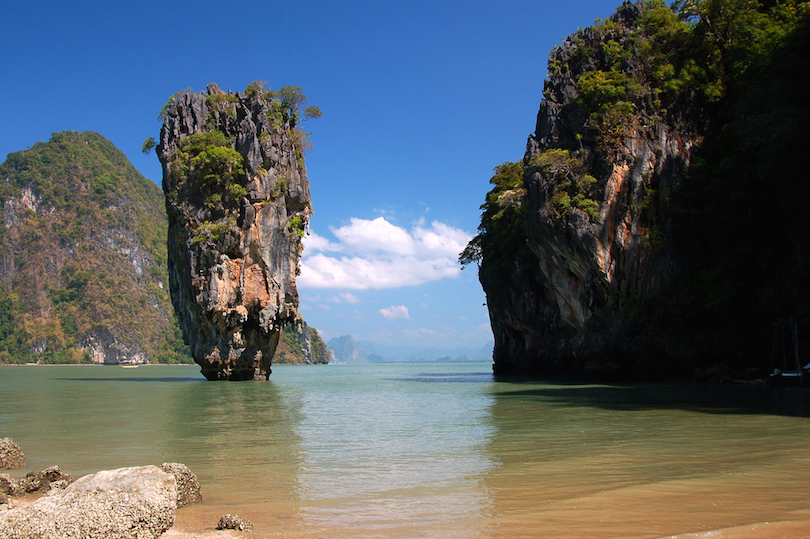
Sea Stack Geology – How Ko Tapu and Other Stacks Form
A sea stack is a steep, isolated column of rock standing in the sea, separated from a cliff by erosion. The most famous example in Phang Nga Bay is Ko Tapu (the nail rock). This page explains the step‑by‑step process of sea stack formation – from a solid cliff to a lonely tower – in simple language. Understanding this process helps you appreciate why Ko Tapu looks the way it does and why it will eventually disappear.
🗻 See a sea stack up close 🗻
Our tours stop right in front of Ko Tapu. Learn the geology from your guide while looking at the real thing. Tours start around 1,500 THB per person.
🚤 Book a Geology Tour →What Is a Sea Stack?
A sea stack is a pillar of rock that stands alone in the water, cut off from the main coastline or island. It is the final stage of coastal erosion. Sea stacks can range from small boulders to massive towers like Ko Tapu (20 metres tall) or even taller ones in other parts of the world (e.g., the Twelve Apostles in Australia). The key feature is that it is completely surrounded by water and cannot be reached from land without a boat.
The Five Stages of Sea Stack Formation
Sea stacks do not appear overnight. They take hundreds of thousands of years to form. Here are the stages, using a limestone cliff as an example:
- Stage 1 – Intact cliff: A limestone cliff meets the sea. Waves crash against the base, especially during storms. The rock is hard, but over time, the constant battering weakens it.
- Stage 2 – Sea notch or cave: Waves erode a depression at the base of the cliff – this is called a “sea notch”. As the notch deepens, it becomes a sea cave. The cave grows inward.
- Stage 3 – Arch formation: If the cave cuts completely through a narrow headland or promontory, it creates a natural arch. The cliff now has a hole in it. The arch continues to be eroded.
- Stage 4 – Stack formation: The roof of the arch collapses because it is no longer supported. What remains is a pillar of rock separated from the main cliff – a sea stack. The stack now stands alone.
- Stage 5 – Collapse and disappearance: The stack continues to be undercut by waves. Eventually, it becomes unstable and collapses into the sea. All that remains is a submerged rock or a small reef.
Ko Tapu is currently in Stage 4 – a fully formed stack. It is still being undercut at its base, but it may stand for several thousand more years before collapsing.
Why Is Ko Tapu a Special Sea Stack?
Ko Tapu is unusual because it is not attached to a headland – it broke away from Khao Phing Kan, which is itself a twin‑hill island. The arch that once connected it collapsed long ago. Today, Ko Tapu stands 40 metres away from Khao Phing Kan. The water between them is only a few metres deep, showing that the two were once connected. The stack is shaped like a nail because the softer rock at the base eroded faster, leaving a narrower “stem” and a wider “head”. The stack is made of limestone, which is slightly soluble in rainwater, but the main erosion force here is waves.
What Will Happen to Ko Tapu in the Future?
Ko Tapu will eventually collapse. The undercut notch at its base grows deeper each year. Once the notch reaches about one‑third of the stack’s width, the stack becomes unstable. A storm or an earthquake could trigger its fall. However, on a human time scale, this will take many generations – perhaps 2,000 to 5,000 years. The national park does not intervene to protect it, because erosion is a natural process. When it falls, a new reef will form from the rubble, and Phang Nga Bay will have a slightly different skyline.
Other Sea Stacks in Phang Nga Bay
Ko Tapu is the most famous, but there are several smaller sea stacks in the bay. Look for them near Panak Island and Hong Island. Some are only a few metres tall and barely break the surface at high tide. Guides often point them out as “baby stacks”. The bay also has many sea caves and arches that will one day become stacks.
How to Observe Sea Stack Geology on Your Tour
When you visit Ko Tapu, look for:
- The undercut notch at the base – a dark band where waves have eaten into the rock.
- The colour difference between the wet lower part (darker) and the dry upper part (lighter).
- The scattered rocks at the base – pieces that have already fallen.
- The distance to Khao Phing Kan – imagine an arch once connecting them.
Your guide can point out these features. For a deeper dive into the overall karst landscape, see our Limestone Karst Formation page.
Frequently Asked Questions About Sea Stacks
Q: How tall is Ko Tapu?
A: About 20 metres (66 feet) above sea level. Its base is under water, so total height from seabed is about 25 metres.
Q: Can I climb Ko Tapu?
A: No. It is forbidden, dangerous, and the rock is fragile. Visitors must stay at least 10 metres away.
Q: Are there sea stacks in other parts of Thailand?
A: Yes, the most famous are in Krabi (Railay Beach) and in the Similan Islands. Phang Nga Bay has the highest concentration.
Q: How fast is Ko Tapu eroding?
A: Very slowly – perhaps 1‑2 centimetres per decade. It will not collapse in our lifetime.
Q: Why is the rock black at the waterline?
A: Algae and small shellfish grow on the wet rock. It is natural, not pollution.
Q: Do sea stacks only form in limestone?
A: No, they can form in any rock type, but limestone erodes faster, so sea stacks are more common in limestone areas.
Final Word From Local Experts
When you stand on the boat looking at Ko Tapu, you are seeing a moment in geological time. The nail rock has been there for the entire history of human civilisation, but it is not permanent. That is part of its beauty – it is fragile, rare, and temporary. Treat it with care. Do not touch it. Do not speed close to it (boat wakes add to erosion). And take a good, long look. You may be one of the last generations to see it exactly as it is today.
Remember the Thai phrase: “Klang nam, klang din” – between water and earth. Enjoy the balance.
— Written by the team at VisitJamesBondIsland.com